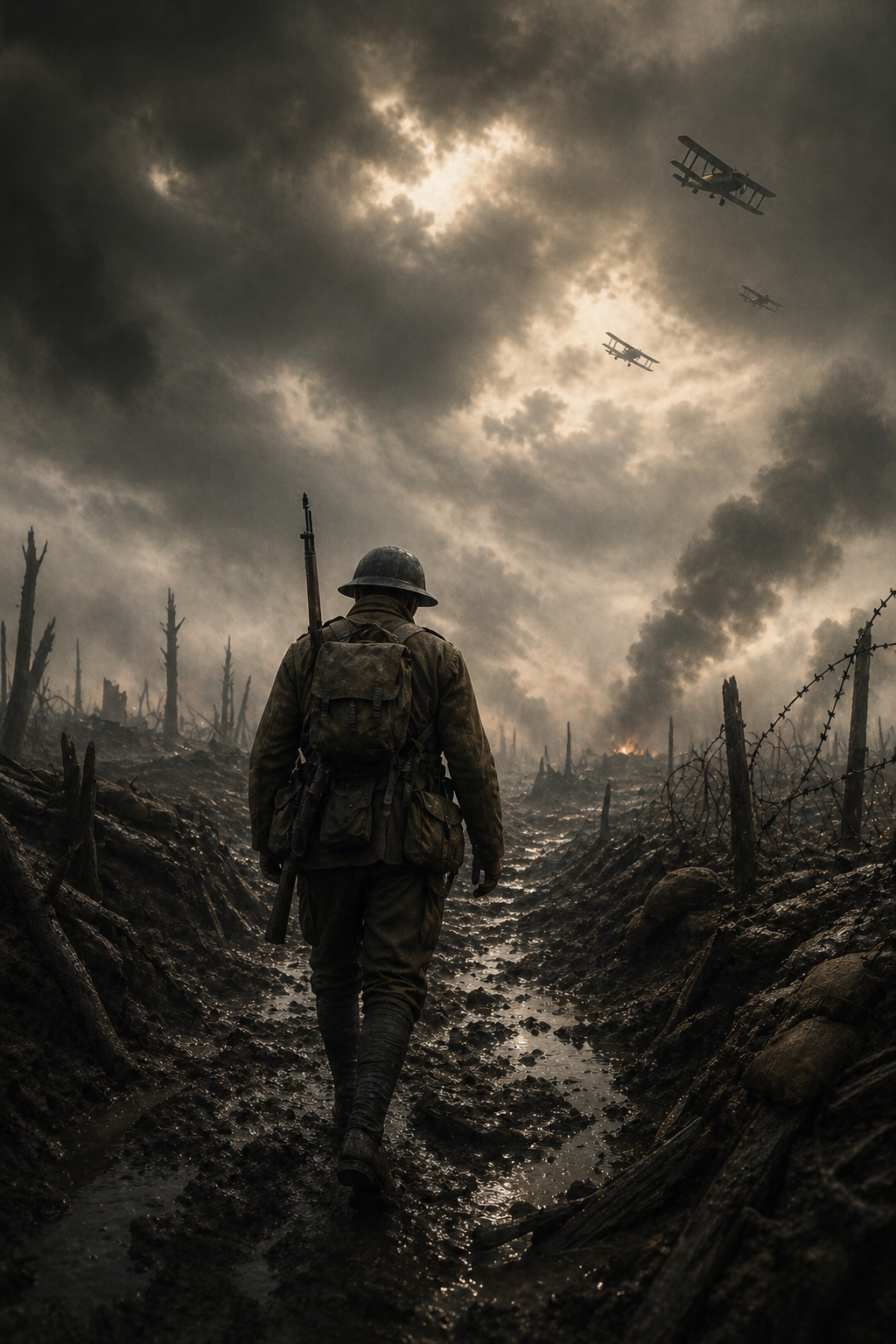
In the spring of 2026, Stanley Underhill — a Birmingham historian specialising in the tactical operations of the First World War — acquires a restored Magneto field telephone at a Solihull estate auction. When he cranks it that evening, a voice comes through the static: a British soldier, somewhere in the mud of Flanders, 1917. What follows is an impossible connection across a century — two men, speaking on a line that has no right to carry anything, who find in each other something neither expected. The soldier calls himself Tommy. The historian calls himself Falcon. Neither gives his real name. Neither asks too hard about the other’s.
The Signal moves between two timelines and four of the war’s defining operations — Messines, the German counter-attack at Cambrai, the Spring Offensive, and the counter-attack at Villers-Bretonneux — as Falcon uses his knowledge of the historical record to guide Tommy through ground the younger man cannot yet see. It is a novel about what it costs to know the future and be unable to change it, about the bond that forms between two men separated by a hundred years and connected by a telephone wire, and about the way the past reaches forward into the present in ways that cannot be planned or predicted — only, eventually, understood.